


Ginseng Roots: A Memoir by Craig Thompson (Pantheon Books). In Ginseng Roots, Thompson returns to his roots as a child in rural Wisconsin, where he and his brother discovered comics and earned money doing farm labor ($1 an hour to them meant “one comic book an hour!”) The work was mostly weeding and otherwise tending to ginseng, as the area was the world’s leading ginseng producer in the 1980s. Thompson’s art is intricate, his layouts are varied, and he packs a lot of information, both about his own life (who knew he had a sister?) and about the history and lore of ginseng, into this volume.

Minor Arcana vols. 1 & 2 by Jeff Lemire (BOOM! Studios). When Theresa returns to her hometown of Limberlost to help care for her ailing mother, a phony psychic, she’s mad as hell but also uncertain about who she is and what direction she wants her life to take. I have never felt so seen. Add in that this series is organized around the tarot deck (mostly the major arcana so far, but who knows what’s to come?), that Theresa discovers she has real psychic powers, and that the town is packed with secrets, and I can’t wait to see the future installments of this series.
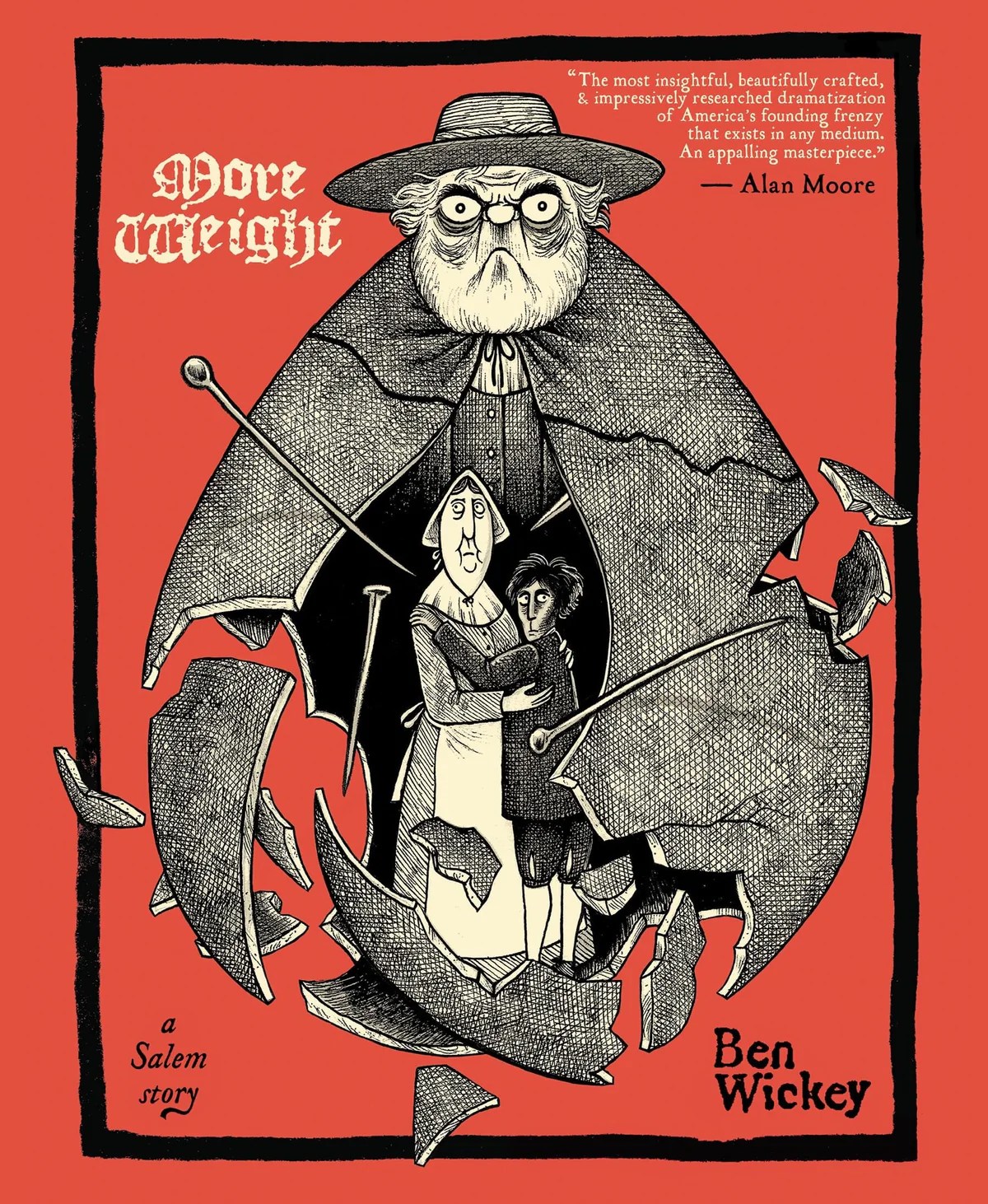
More Weight: A Salem Story by Ben Wickey (IDW). Wickey relates the history of Salem across three time periods: the famous witch trials of 1692 (with a little prehistory included), the 1860s (filled with discussion by Nathaniel Hawthorn and Henry Wadsworth about the town’s history including Hawthorne’s great-great grandfather Judge John Hathorne, a key player in the witch trials), and the present day (in which the town’s association with witchcraft has become a lure for tourists). He draws on a variety of artistic styles for expressive purposes, including woodcut-like grayscale, sepia tones, and flashes of expressionist color.

Photographic Memory: William Henry Jackson and the American West by Bill Griffith (Abrams ComicArts). Who knew the creator of Zippy the Pinhead was also the great grandson of the noted photographer William Henry Jackson? Me, after I read this graphic biography which includes the author’s experience learning about the connection. Jackson seems to have been quite a character: among other things he served in the Union army, worked as a bullwhacker (oxen driver) on a wagon train, was commissioned by the Union Pacific to chronicle scenery along the rail lines, and travelled the world to photograph and collect specimens for Chicago’s Field Museum. Griffith’s detailed, realistic style works well to narrate a story that needs no embellishment, and this volume also includes bibliographic references, and reproductions of 15 of Jackson’s photographs.

Precious Rubbish by Kayla E. (Fantagraphics). The power of Kayla E’s book about what seems to have been a nightmarishly abusive childhood comes from the contrast between the innocuous artistic styles she draws on and the content she includes. Her art echoes mid-century classics like Archie Comics and Cookie and kid’s activity books, so all seems well until you notice that a word search puzzle includes “incest” and “trauma,” paper doll cutouts include a mother doll holding a paddle, and the solution to a word scramble is “pedophilia.” In the endnotes, she cites the specific artistic models she used, assuring you that nothing in this book is there by accident.
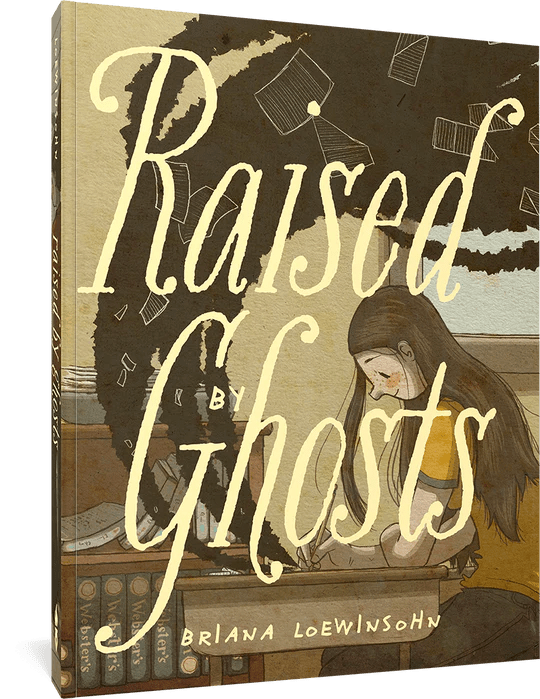
Raised by Ghosts by Briana Loewinsohn (Fantagraphics). Loweinsohn’s childhood echoes that of a lot of creative people—she was a lonely and picked-on outsider raised by a neglectful parent until she found her tribe and through them her talent and suddenly life became a lot easier to bear. And yet the story told in this volume is uniquely her own, standing out due to the author’s perceptive observations (“Middle school is like a blur of new yet boring puzzles”), expressive artistic style, and inclusion of period detail (writing notes to your friends, and folding them in very specific ways, was a big deal at her high school). She portrays the voices of people not important to her as a series of meaningless marks, recalling the way adult speech is rendered by nonverbal sounds in the Charlie Brown TV specials, and her transition from outcast to artist is signaled by a departure from her previously naturalistic art to a wild mix of abstract patterns.
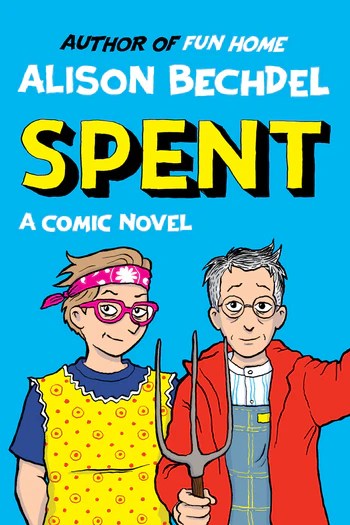
Spent: A Comic Novel by Alison Bechdel (Mariner Books). Like the characters of Frank King’s Gasoline Alley, the denizens of Bechdel’s Dykes to Watch Out For have aged along with their creator, which is a good thing since a character sharing her name and likeness is central to this book. “Alison” and her partner Holly manage a pygmy goat sanctuary in Vermont and Alison’s memoir has been sold to television. Ginger, Lois, Sparrow, and Stuart share a house just down the road and experiment with polyamory. Everyone is terribly concerned about properly organic food and finding anti-colonial ways to celebrate Thanksgiving. Spent is lighter in tone than Bechtel’s previous autobiographical works but embodies the hope that it’s possible to get older and wiser without abandoning your radical principles.

Tongues by Anders Nilsen (Pantheon). This large-format book (about the size of a high school yearbook) collects work Nilsen has been publishing since 2017. It mixes together several story lines, including one about Prometheus, who in this version suffers in a war-torn desert country for the sin of giving humans language; one about an American backpacker with a teddy bear strapped to his back; and one about an East African girl on an assassination mission. It’s amazingly rich in both art and narrative and is never less than fascinating even as it’s also a lot to follow.

Will Eisner: A Comics Biographyby Stephen Weiner & Dan Mazur (nbm). I can think of no better way to communicate the life and work of pioneering cartoonist Will Eisner (among other things, he created the long-running character The Spirit and pioneered the studio system of comics creation) than through the medium of comics. That’s exactly what artist Dan Mazur and historian Stephen Weiner do in this volume, which offers a great introduction to Eisner’s life and work. Mazur’s art is straightforward but gets the job done, while the breadth of the subject material included (which includes the urban immigrant experience and history of the early comics industry as well as Eisner’s life) is admirable.

Witchcraft by Sole Otero (Fantagraphics). It was a dark and stormy night in 1768 when a ship carrying three mysterious strangers arrived at Buenos Aires. Strange events follow and rumors of witchcraft begin to dog María Fátima, María Lourdes, and María Mercedes, but pity the fool that crosses them. Otero’s wildly creative story jumps around in time and place, and her art could not be more varied, but it’s all held together through the author’s vision and strong sense of forward momentum. | Sarah Boslaugh
